
Sitting in the Car With the Engine On
Anxiety, Safety & Coming Home to Yourself
Joanne Harrison
5/18/20265 min read
Self & Shadow Therapy
Nervous System · Anxiety · Healing
You've arrived. You survived whatever needed surviving. And yet — the engine is still running. Your body is still braced. Your mind is still scanning. Something in you hasn't received the message that it's safe to get out of the car.
If that resonates, this article is for you.
This isn't a clinical breakdown of anxiety. It's an honest conversation about two very different states your nervous system can live in — and why understanding the difference might be one of the most compassionate things you ever do for yourself.
✦
What Anxiety Actually Is
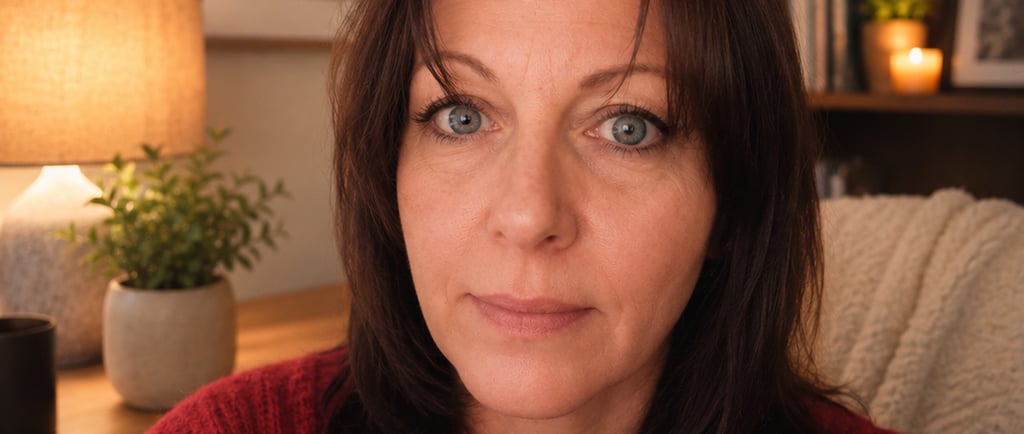
When I sit with someone in their first few sessions, I don't need them to tell me they're anxious. I can see it before a single word is spoken. There's a tension in the gaze — watchful, scanning. A tightness in the body. An urgency, as though the room itself might shift into danger at any moment. They are hyper-focused, but not on the present. They are focused on what might happen, what could go wrong, what needs to be controlled before it controls them.
This is the anxious nervous system doing exactly what it was designed to do: protect you. The amygdala — your brain's threat detection centre — has fired. Cortisol and norepinephrine are flooding your system. Your body has mobilised for danger.
The problem is not that this system exists. The problem is that it keeps running long after the danger has passed.
"Anxiety is not a flaw in your character. It is a state of being — one your nervous system learned was necessary to keep you safe."
One of the most important things I gently challenge in my work is the belief that anxiety belongs to us — as though it is something we own, a permanent fixture of who we are. "I have anxiety" slowly becomes "I am anxious," and before long, the nervous system begins defending that identity as though letting go of it would mean losing yourself entirely.
But anxiety is not yours to keep. It is a state you move through — not a self you are stuck inside.
✦
The Guard at the Door
From a deeper psychological perspective, anxiety is rarely just noise. In my experience sitting with clients, anxiety functions as both a guard and a protector — standing at the entrance to parts of us that are unresolved, unheard, and tender.
Those parts aren't dangerous. But they feel that way. They carry old grief, unmet needs, moments where we weren't held, understood, or seen. The nervous system experienced those moments as threats to survival — because emotionally, they were. And so anxiety stepped in to guard the door.
Then comes the forecasting. The anxious mind projects danger into the future, imagines worst-case scenarios, and generates evidence that the threat is real — even when it isn't. The guard feels justified. The door stays locked. And the unresolved parts inside never get the chance to be heard.
A Clinical Observation
The negative forecasting loop is self-sealing. The imagination creates the danger, the body responds to it as real, and the nervous system takes that physical response as proof that the threat exists. Understanding this loop — not fighting it — is often where healing begins.
What lies beneath anxiety, in my experience, is almost never what the client expects. It is usually something much more human: a longing to be loved without conditions, a grief that never had space to breathe, a younger part of the self still waiting to be told it's safe.
✦
What Safety Mode Actually Feels Like
I want you to think about a moment — perhaps a rare one — when you felt genuinely at ease. Not numb. Not distracted. Actually present. Your shoulders dropped. Your breath came more easily. You laughed and it reached your eyes. You could hold someone else's perspective without it threatening your own.
That was your nervous system in what researchers call the ventral vagal state — or what I simply call safety mode.
This isn't the absence of feeling. It's a different quality of aliveness entirely. When I watch a client shift into this state in session — and I have the privilege of watching it happen — the transformation is visible. The body softens. The gaze opens. They become curious rather than defensive. They can suddenly see their situation from multiple angles, perspectives that were completely inaccessible moments before.
That's not magic. That's the prefrontal cortex — the part of the brain responsible for reasoning, empathy, and nuance — coming back online.
Safety mode makes possible what anxiety blocks entirely: the ability to be present with the people you love, to be kind to yourself without it feeling false, to give yourself permission — real, felt permission — to simply enjoy being alive.
✦
The Car with the Engine Still Running
When I explain the nervous system to clients, I often say this:
Your nervous system has done its job. It protected you — through situations you didn't have the emotional resources to process, through grief, through environments that weren't safe. It kept you alive. But it's still running, even though you've already survived what you needed to.
It's like driving to your destination, parking the car — and then just sitting there. Engine on. Hands on the wheel. Waiting for a road that's already behind you. Life is outside that car. The people you love are outside. The version of yourself you're becoming is outside. But the nervous system hasn't received the memo that it's time to step out.
This is not weakness. This is not a disorder. This is a human nervous system doing what nervous systems do — running the last programme that kept you safe, until it's shown a new one.
What This Means Practically
You cannot think your way out of an anxious nervous system state. Insight alone rarely shifts it, because anxiety operates below the level of conscious reasoning. The body needs to be shown safety — through breath, through relationship, through small repeated experiences of surviving the present moment — before the mind can follow.
✦
You Don't Need to Be Fixed
There is nothing wrong with you.
I want to say that again, because most people who sit across from me have spent years quietly believing the opposite.
Anxiety is part of the human experience. Every person alive has this system. It presents differently — shaped by history, by temperament, by what life asked of us before we had the tools to respond. But the nervous system itself is not broken. It is doing exactly what it learned to do.
What it needs is not correction. It needs guidance. New information. The experience — slowly, safely, and repeatedly — that the present is not the past.
Think of a world-class athlete. Nobody questions whether they need a coach. The coach doesn't mean the athlete is broken — it means they are serious about becoming more of what they already are. Therapy works the same way. It is a space to navigate your inner landscape with someone who has a map — and who has, in some cases, walked that terrain themselves.
✦
If you are reading this alone tonight, in that quiet place where anxiety speaks loudest — I want you to hear this:
You don't have all the pieces yet. Not because you've failed, but because nobody handed them to you. The pieces that build the ladder out of this. The pieces that make the engine finally quiet.
You have been living with this daily. You know how exhausting it is. Asking for guidance takes courage — it asks you to be vulnerable, to admit you don't have to carry this alone. But when you face it with support, something shifts. You begin to navigate rather than survive. You make peace — not by erasing anxiety, but by understanding it.
You won't stop feeling anxious forever. But you will learn to pull the handbrake before it goes too deep. You will learn to recognise the state, to name it without becoming it, and to find your way back to yourself — one small, real, human step at a time.
We are better as a team than as individuals. You were never meant to figure this out alone.
The door of the car is right there. Whenever you're ready.
Self & Shadow Therapy A therapeutic space for those ready to understand themselves more deeply — with honesty, compassion, and genuine human presence.
Connect
Call
hello@selfandshadowtherapy.co.uk
+++kkk716
© 2025. All rights reserved.
07841010092